



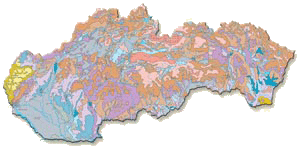
Soil Susceptibility to Acidification, Čurlík, J., scale 1 : 1,000,000, The Landscape Atlas of the Slovak Republic, 2002
The capacity of soils to resist to acidification depends on the content of carbonates, humus, clayey minerals, and salts. The least prone to acidification are the carbonate and alkaline soils where the pH does not significantly change (the carbonate controlling system). The soils pertaining to different soil units (carbonate Chernozems, Histi-Mollic Gleysols, Fluvisols, Rendzinas, Solonchals and Solonetzs) are in this group. On the other side, there are the very washed out (leached) soils of mountain areas where pH does not change significantly due to their extreme acidity (aluminium controlling system). Four classes of soils with different susceptibility to acidification depending on their buffer capacities controlled by the content of clay, humus and basic ions are classified into this group. Very sensitive (prone to acidification) are the light sandy soils with low content of humus and clay where pH in slightly acid to neutral areas is maintained by calcification and fertilisation.