


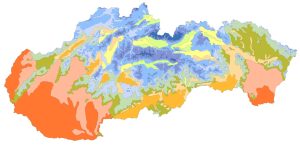
Climatic-Geographic Types, Kočický, D. and Ivanič, B., 2011, scale 1:50,000
From 2007 to 2011, the Slovak Geological Survey (ŠGÚDŠ), in cooperation with the company Esprit Banská Štiavnica, carried out a geological project “Comprehensive Geological Information Base for Nature Conservation and Landscape Management (GIB-GES).” As part of this project, a climatogeographic classification of the climate was also developed. The climate in Slovakia is highly diverse. Its character depends on the intensity of solar radiation, atmospheric circulation, elevation, and the region’s distance from the sea. These are the most important climate-forming factors that influence temperature patterns, precipitation, and cloud cover. Slovakia lies within a transitional, Central European climate zone characterized by a temperate climate, with regular seasonal changes and a prevailing westerly flow. In the western and northwestern parts, the influence of the Atlantic Ocean predominates, while in the south and east, the influence of the Mediterranean climate and the continental climate of Eurasia prevails. Another significant climatogenic factor is the highly rugged topography of Slovakia and the zonal arrangement of its mountain ranges, which create a barrier effect. The degree of maritime influence on the climate reaches 50% in the western part of the country, while the degree of continental influence rises to 55% toward the east. This results in more extreme winters in eastern Slovakia and longer, drier summers with more sunshine than in the western part of the country (Špánik, Šiška et al., 2004). Slovakia’s climate is divided into three basic climatogeographic types:
• lowland climate with moderate temperature inversion, dry to moderately dry,
• basin climate with significant temperature inversion, moderately dry to humid,
• mountain climate with a small temperature inversion, humid to very humid.